
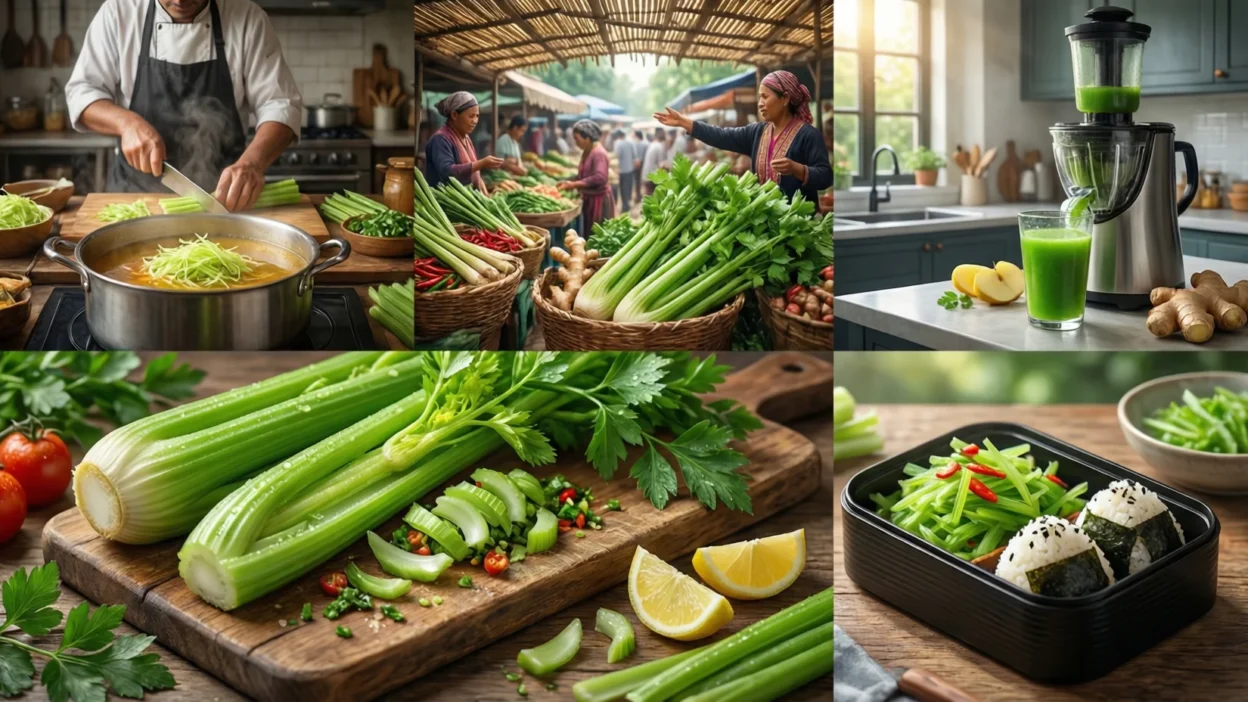
Celery is a widely used vegetable known for its crisp texture, fresh taste, and health benefits.
People use celery in soups, salads, juices, and traditional dishes across many cultures. Because of its global presence, learning how to say celery in different languages helps travelers, home cooks, chefs, food bloggers, translators, and language learners communicate clearly.
Moreover, celery often appears in recipes, grocery shopping, and nutrition discussions. Therefore, knowing its native names improves understanding.
Additionally, food related vocabulary builds stronger cultural connections. As a result, this guide presents celery translations from around the world using natural example sentences for practical use.
| Language | Native Phrase | Example Sentence |
|---|---|---|
| English | Celery | Celery tastes fresh. |
| Spanish | Apio | El apio es crujiente. |
| French | Céleri | Le céleri est frais. |
| German | Sellerie | Sellerie ist gesund. |
| Italian | Sedano | Il sedano è croccante. |
| Portuguese | Aipo | O aipo é verde. |
| Dutch | Selderij | Selderij is knapperig. |
| Swedish | Selleri | Selleri är nyttigt. |
| Norwegian | Selleri | Selleri er sunt. |
| Danish | Selleri | Selleri er sprødt. |
| Finnish | Selleri | Selleri on raikas. |
| Icelandic | Sellerí | Sellerí er hollt. |
| Russian | Сельдерей | Сельдерей полезен. |
| Ukrainian | Селера | Селера свіжа. |
| Polish | Seler | Seler jest zdrowy. |
| Czech | Celer | Celer je křupavý. |
| Slovak | Zeler | Zeler je čerstvý. |
| Hungarian | Zeller | A zeller ropogós. |
| Romanian | Țelină | Țelina e proaspătă. |
| Greek | Σέλινο | Το σέλινο είναι φρέσκο. |
| Turkish | Kereviz | Kereviz sağlıklıdır. |
| Arabic | كرفس | الكرفس طازج. |
| Hebrew | סלרי | סלרי בריא. |
| Persian | کرفس | کرفس تازه است. |
| Urdu | اجوائن | اجوائن تازہ ہے۔ |
| Hindi | अजवाइन | अजवाइन ताज़ा है। |
| Bengali | সেলারি | সেলারি কচকচে। |
| Punjabi | ਸੈਲਰੀ | ਸੈਲਰੀ ਤਾਜ਼ੀ ਹੈ। |
| Tamil | செலரி | செலரி تازாக உள்ளது. |
| Telugu | సెలరీ | సెలరీ తాజాగా ఉంది. |
| Kannada | ಸೆಲರಿ | ಸೆಲರಿ ತಾಜಾ. |
| Malayalam | സെലറി | സെലറി تازമാണ്. |
| Marathi | सेलरी | सेलरी ताजी आहे. |
| Gujarati | સેલરી | સેલરી તાજી છે. |
| Nepali | सेलरी | सेलरी ताजा छ। |
| Sinhala | සෙලරි | සෙලරි නැවුම්. |
| Chinese (Simplified) | 芹菜 | 芹菜很新鲜。 |
| Chinese (Traditional) | 芹菜 | 芹菜很脆。 |
| Japanese | セロリ | セロリは新鮮です。 |
| Korean | 셀러리 | 셀러리는 아삭하다. |
| Thai | ขึ้นฉ่าย | ขึ้นฉ่ายสด |
| Vietnamese | Cần tây | Cần tây giòn. |
| Indonesian | Seledri | Seledri segar. |
| Malay | Saderi | Saderi segar. |
| Filipino | Kintsay | Malutong ang kintsay. |
| Swahili | Selari | Selari ni mbichi. |
| Afrikaans | Seldery | Seldery is vars. |
| Somali | Selari | Selari waa cusub. |
| Hausa | Seleri | Seleri sabo ne. |
| Yoruba | Selari | Selari tutu. |
| Igbo | Selari | Selari dị ọhụrụ. |
| Zulu | Isilimo eselery | Isilimo sisanda. |
| Amharic | ሴለሪ | ሴለሪ ትኩስ ነው። |
| Lao | ຊີເລີຣີ | ຊີເລີຣີສົດ |
| Khmer | សេលរី | សេលរីស្រស់ |
| Mongolian | Селөдерей | Селөдерей шинэхэн. |
| Kazakh | Балдыркөк | Балдыркөк жаңа. |
| Uzbek | Selderey | Selderey yangi. |
| Tajik | Карафс | Карафс тару тоза аст. |
| Pashto | کرفس | کرفس تازه دی. |
| Kurdish | Kerefs | Kerefs taze ye. |
| Armenian | Նեխուր | Նեխուրը թարմ է։ |
| Georgian | ნიახური | ნიახური تازهა. |
| Albanian | Selino | Selino është i freskët. |
| Bosnian | Celer | Celer je svjež. |
| Croatian | Celer | Celer je hrskav. |
| Serbian | Целер | Целер је свеж. |
| Bulgarian | Целина | Целината е прясна. |
| Slovenian | Zelena | Zelena je sveža. |
| Lithuanian | Salieras | Salieras šviežias. |
| Latvian | Selerija | Selerija svaiga. |
| Estonian | Seller | Seller on värske. |
| Irish | Soilire | Tá soilire úr. |
| Welsh | Selari | Mae selari’n ffres. |
| Basque | Apioa | Apioa freskoa da. |
| Catalan | Api | L’api és fresc. |
| Galician | Apio | O apio é fresco. |
| Maltese | Karfus | Il-karfus frisk. |
| Esperanto | Celerio | Celerio freŝas. |
| Latin | Apium | Apium recens est. |
Final Thought
Celery may seem like a simple vegetable, yet it connects cuisines and cultures worldwide.
Therefore, learning celery in different languages improves everyday communication, especially in cooking, travel, and nutrition. Moreover, it helps readers understand recipes accurately.
Additionally, language learners gain useful food vocabulary. As a result, conversations become clearer.
Furthermore, cultural appreciation grows through shared food terms. Ultimately, one humble vegetable shows how language and food unite people across the globe.

Foster Hollis is a language and culture writer with a strong interest in how people communicate across borders. At Lingonast, he focuses on cultural insights and language based articles that help readers understand global traditions in a simple, engaging way.