
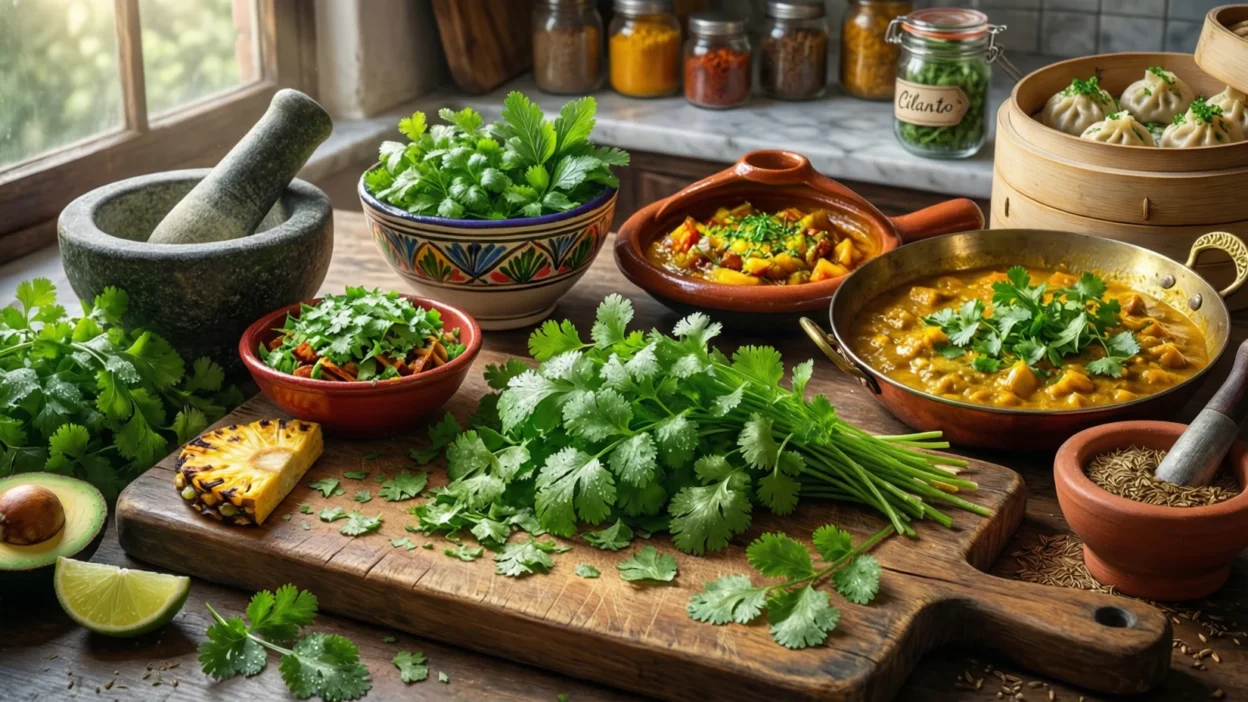
Cilantro is a popular herb used in cuisines around the world. Moreover, it adds a fresh, citrus like flavor to many dishes, including salads, sauces, curries, and soups.
Therefore, people commonly use it in cooking, food blogs, recipes, and restaurant menus. Additionally, cilantro plays an important role in traditional dishes across Asia, the Middle East, Latin America, and Europe.
Furthermore, learning cilantro in different languages helps travelers order food confidently.
As a result, chefs and home cooks communicate ingredients more clearly. Meanwhile, language learners expand food related vocabulary. Similarly, food writers and bloggers improve accuracy.
Consequently, knowing native terms for cilantro avoids confusion, especially because some regions use different names. Ultimately, food vocabulary connects cultures through shared taste and tradition.
| Language | Native Phrase | Example Sentence |
|---|---|---|
| English | Cilantro | Cilantro adds fresh flavor. |
| Spanish | Cilantro | El cilantro es fresco. |
| French | Coriandre | La coriandre est parfumée. |
| German | Koriander | Koriander schmeckt frisch. |
| Italian | Coriandolo | Il coriandolo è aromatico. |
| Portuguese | Coentro | O coentro é popular. |
| Dutch | Koriander | Koriander is groen. |
| Swedish | Koriander | Koriander används ofta. |
| Norwegian | Koriander | Koriander gir smak. |
| Danish | Koriander | Koriander er frisk. |
| Finnish | Korianteri | Korianteri tuoksuu. |
| Russian | Кинза | Кинза ароматная. |
| Ukrainian | Кінза | Кінза свіжа. |
| Polish | Kolendra | Kolendra pachnie. |
| Czech | Koriandr | Koriandr chutná. |
| Slovak | Koriander | Koriander je čerstvý. |
| Hungarian | Koriander | Koriander illatos. |
| Romanian | Coriandru | Coriandrul este verde. |
| Greek | Κόλιανδρος | Ο κόλιανδρος μυρίζει. |
| Turkish | Kişniş | Kişniş tazedir. |
| Arabic | كزبرة | الكزبرة طازجة. |
| Hebrew | כוסברה | כוסברה ריחנית. |
| Persian | گشنیز | گشنیز خوشبو است. |
| Urdu | دھنیا | دھنیا تازہ ہے۔ |
| Hindi | धनिया | धनिया खुशबूदार है। |
| Bengali | ধনিয়া | ধনিয়া তাজা। |
| Punjabi | ਧਨੀਆ | ਧਨੀਆ ਸੁਗੰਧੀ ਹੈ। |
| Tamil | கொத்தமல்லி | கொத்தமல்லி மணமுள்ளது. |
| Telugu | కొత్తిమీర | కొత్తిమీర తాజాది. |
| Kannada | ಕೊತ್ತಂಬರಿ | ಕೊತ್ತಂಬರಿ ಸುಗಂಧ. |
| Malayalam | മല്ലിയില | മല്ലിയില പുതിയത്. |
| Marathi | कोथिंबीर | कोथिंबीर सुगंधी आहे. |
| Gujarati | ધાણા | ધાણા તાજું છે. |
| Chinese (Simplified) | 香菜 | 香菜很新鲜。 |
| Chinese (Traditional) | 香菜 | 香菜很香。 |
| Japanese | パクチー | パクチーは新鮮。 |
| Korean | 고수 | 고수가 향긋하다. |
| Thai | ผักชี | ผักชีสด |
| Vietnamese | Rau mùi | Rau mùi thơm. |
| Indonesian | Ketumbar | Ketumbar segar. |
| Malay | Ketumbar | Ketumbar wangi. |
| Filipino | Wansoy | Mabango ang wansoy. |
| Swahili | Giligilani | Giligilani safi. |
| Afrikaans | Koljander | Koljander ruik lekker. |
| Somali | Kabsar | Kabsar waa cusub. |
| Hausa | Kaskas | Kaskas sabo ne. |
| Yoruba | Ata ilẹ̀ | Ata ilẹ̀ dùn. |
| Igbo | Kọlịandà | Kọlịandà dị ọhụrụ. |
| Zulu | Ikhoriyanda | Ikhoriyanda inuka. |
| Amharic | ደንድነ | ደንድነ አዲስ ነው። |
| Nepali | धनियाँ | धनियाँ ताजा छ। |
| Sinhala | කොත්තමල්ලි | කොත්තමල්ලි සුවඳයි. |
| Lao | ຜັກຊີ | ຜັກຊີຫອມ |
| Khmer | ជីវ៉ាន់ស៊ុយ | ជីវ៉ាន់ស៊ុយស្រស់ |
| Mongolian | Кинза | Кинза анхилуун. |
| Kazakh | Кинза | Кинза хош иісті. |
| Uzbek | Kinzа | Kinza yangi. |
| Tajik | Кинза | Кинза хушбӯй аст. |
| Pashto | دڼیا | دڼیا تازه ده. |
| Kurdish | Geznewî | Geznewî têxweş e. |
| Armenian | Կորիանդր | Կորիանդրը բուրավետ է։ |
| Georgian | ქინძი | ქინძი სურნელოვანია. |
| Albanian | Koriandër | Koriandri i freskët. |
| Bosnian | Korijander | Korijander miriše. |
| Croatian | Korijander | Korijander je svjež. |
| Serbian | Коријандер | Коријандер мирише. |
| Bulgarian | Кориандър | Кориандърът е свеж. |
| Slovenian | Koriander | Koriander diši. |
| Lithuanian | Kalendra | Kalendra kvepia. |
| Latvian | Koriandrs | Koriandrs smaržo. |
| Estonian | Koriander | Koriander lõhnab. |
| Icelandic | Kóríander | Kóríander ilmar. |
| Irish | Lus an choireandair | Lus úr. |
| Welsh | Coriander | Coriander ffres. |
| Basque | Koriandroa | Koriandroa freskoa. |
| Catalan | Coriandre | Coriandre fresc. |
| Galician | Coentro | Coentro fresco. |
| Esperanto | Koriandro | Koriandro bonodoras. |
| Latin | Coriandrum | Coriandrum recens est. |
Final Thought
In conclusion, learning cilantro in different languages highlights how food unites cultures. Moreover, this simple herb appears in countless traditional dishes worldwide.
Therefore, knowing its native names improves communication in kitchens and markets. Additionally, travelers feel more confident ordering meals. Consequently, misunderstandings decrease.
Furthermore, food vocabulary enriches cultural understanding. As a result, language learning becomes practical and enjoyable. Ultimately, even one ingredient can tell a global story. Food and language together build strong cultural connections.
FAQs
What is cilantro commonly used for?
It flavors dishes like salads, curries, and sauces.
Is cilantro called the same everywhere?
No, names vary by region and language.
Is coriander the same as cilantro?
Often yes, especially outside North America.
Do all cuisines use cilantro?
Many do, but usage differs by culture.
Why learn cilantro in different languages?
It helps with travel, cooking, and communication.

Nicodemo Thorley is a cultural writer at Lingonast.com, focusing on language and heritage.
He explores how language connects with culture and history.
His articles offer structured and insightful perspectives.