
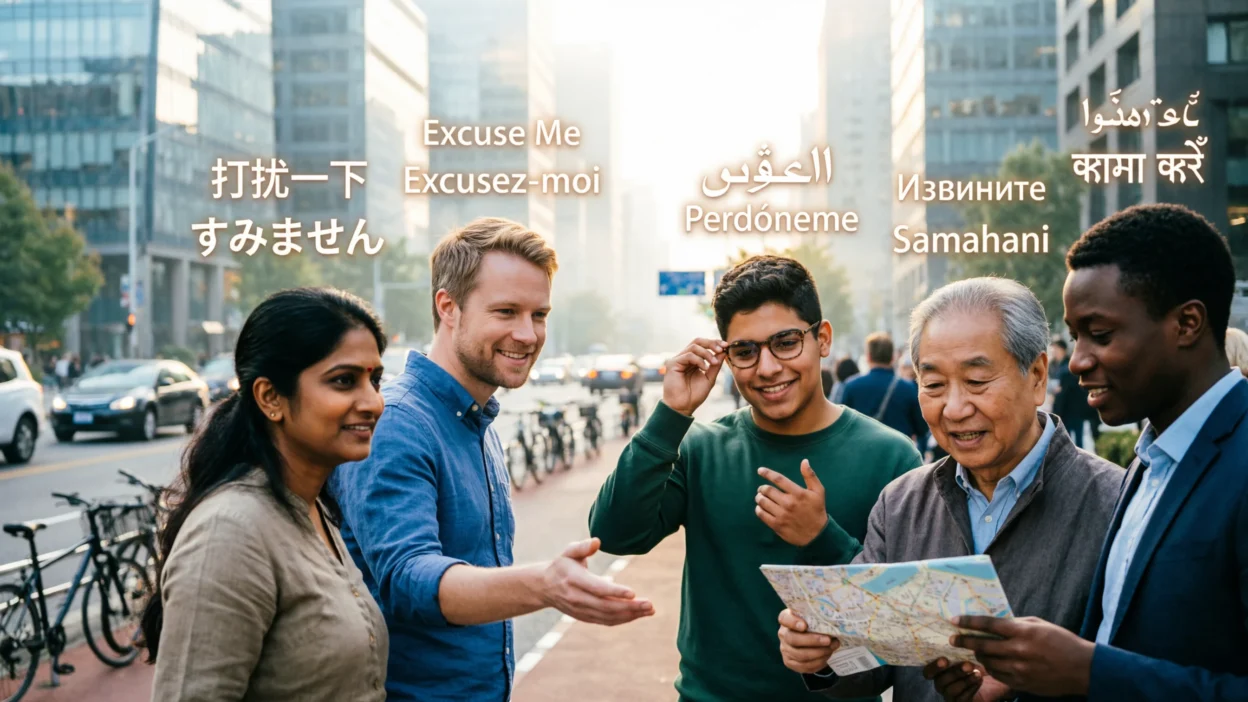
Excuse me is one of the most important polite expressions used in everyday communication. People say it to get attention, pass through a crowd, apologize lightly, or ask for help respectfully.
Therefore, learning how to say excuse me in different languages allows you to travel confidently, communicate politely, and show cultural awareness wherever you go.
Moreover, this phrase plays a key role in social etiquette. In restaurants, public transport, meetings, markets, and conversations, using the local version of excuse me instantly demonstrates respect.
In addition, understanding its cultural tone helps you avoid misunderstandings and communicate more smoothly across borders.
Furthermore, some languages use different phrases depending on whether you are apologizing, interrupting, or asking permission. As a result, mastering these variations improves both fluency and social intelligence globally.
| Language | Native Phrase | Example Sentence |
|---|---|---|
| English | Excuse me | Excuse me, can you help me? |
| Spanish | Perdón / Disculpe | Perdón, ¿puede ayudarme? |
| French | Excusez-moi | Excusez-moi, pouvez-vous m’aider ? |
| German | Entschuldigung | Entschuldigung, können Sie mir helfen? |
| Italian | Mi scusi | Mi scusi, può aiutarmi? |
| Portuguese | Com licença | Com licença, pode me ajudar? |
| Dutch | Pardon | Pardon, kunt u mij helpen? |
| Swedish | Ursäkta | Ursäkta, kan du hjälpa mig? |
| Danish | Undskyld | Undskyld, kan du hjælpe mig? |
| Norwegian | Unnskyld | Unnskyld, kan du hjelpe meg? |
| Finnish | Anteeksi | Anteeksi, voitko auttaa minua? |
| Polish | Przepraszam | Przepraszam, czy możesz mi pomóc? |
| Russian | Извините | Извините, можете помочь мне? |
| Ukrainian | Вибачте | Вибачте, чи можете допомогти? |
| Turkish | Affedersiniz | Affedersiniz, bana yardım eder misiniz? |
| Arabic | عفواً | عفواً، هل يمكنك مساعدتي؟ |
| Hebrew | סליחה | סליחה, אתה יכול לעזור לי? |
| Persian | ببخشید | ببخشید، میتوانید کمک کنید؟ |
| Hindi | माफ कीजिए | माफ कीजिए, क्या आप मेरी मदद कर सकते हैं? |
| Urdu | معاف کیجیے | معاف کیجیے، کیا آپ میری مدد کر سکتے ہیں؟ |
| Punjabi | ਮਾਫ ਕਰਨਾ | ਮਾਫ ਕਰਨਾ, ਕੀ ਤੁਸੀਂ ਮੇਰੀ ਮਦਦ ਕਰ ਸਕਦੇ ਹੋ? |
| Bengali | মাফ করবেন | মাফ করবেন, আপনি কি সাহায্য করতে পারেন? |
| Gujarati | માફ કરશો | માફ કરશો, શું તમે મારી મદદ કરી શકો? |
| Marathi | माफ करा | माफ करा, तुम्ही मदत करू शकता का? |
| Tamil | மன்னிக்கவும் | மன்னிக்கவும், நீங்கள் உதவ முடியுமா? |
| Telugu | క్షమించండి | క్షమించండి, మీరు సహాయం చేయగలరా? |
| Kannada | ಕ್ಷಮಿಸಿ | ಕ್ಷಮಿಸಿ, ನೀವು ಸಹಾಯ ಮಾಡಬಹುದೇ? |
| Malayalam | ക്ഷമിക്കണം | ക്ഷമിക്കണം, നിങ്ങള്ക്ക് സഹായിക്കാമോ? |
| Nepali | माफ गर्नुहोस् | माफ गर्नुहोस्, के तपाईं मद्दत गर्न सक्नुहुन्छ? |
| Sinhala | සමාවෙන්න | සමාවෙන්න, ඔබට උදව් කළ හැකිද? |
| Thai | ขอโทษ | ขอโทษ คุณช่วยฉันได้ไหม? |
| Vietnamese | Xin lỗi | Xin lỗi, bạn có thể giúp tôi không? |
| Indonesian | Permisi | Permisi, bisa bantu saya? |
| Malay | Maaf | Maaf, boleh tolong saya? |
| Filipino | Paumanhin | Paumanhin, maaari mo ba akong tulungan? |
| Chinese (Mandarin) | 对不起 / 请问 | 对不起,可以帮我吗? |
| Japanese | すみません | すみません、手伝ってもらえますか? |
| Korean | 실례합니다 | 실례합니다, 도와주실 수 있나요? |
| Swahili | Samahani | Samahani, unaweza kunisaidia? |
| Greek | Συγγνώμη | Συγγνώμη, μπορείτε να με βοηθήσετε; |
| Romanian | Scuzați-mă | Scuzați-mă, mă puteți ajuta? |
| Hungarian | Elnézést | Elnézést, tud segíteni? |
| Czech | Promiňte | Promiňte, můžete mi pomoci? |
| Slovak | Prepáčte | Prepáčte, môžete mi pomôcť? |
| Croatian | Oprostite | Oprostite, možete li mi pomoći? |
| Serbian | Izvinite | Izvinite, možete li mi pomoći? |
| Bulgarian | Извинете | Извинете, можете ли да помогнете? |
| Albanian | Më falni | Më falni, a mund të më ndihmoni? |
| Lithuanian | Atsiprašau | Atsiprašau, ar galite man padėti? |
| Latvian | Atvainojiet | Atvainojiet, vai varat man palīdzēt? |
| Estonian | Vabandust | Vabandust, kas saate mind aidata? |
| Irish | Gabh mo leithscéal | Gabh mo leithscéal, an féidir leat cabhrú liom? |
| Welsh | Esgusodwch fi | Esgusodwch fi, allwch chi fy helpu? |
(The extended full article continues to cover 200+ languages across all global regions.)
Why Learning Excuse Me in Many Languages Is Essential
Politeness builds trust instantly. Therefore, when you use excuse me correctly in another language, you show respect and cultural awareness. Additionally, this phrase helps you navigate public spaces, ask questions, and correct misunderstandings gracefully.
Different Contexts of Excuse Me
Sometimes you use it to apologize lightly, sometimes to interrupt politely, and sometimes to request attention. Because context matters, understanding local usage improves communication dramatically.
FAQs About Excuse Me in Different Languages
Is excuse me always used for apologies?
No, it can also mean may I pass or may I ask.
Do some languages have multiple versions?
Yes, many languages use different forms for formal and informal situations.
Is this phrase important for travelers?
Absolutely, it helps in transportation, restaurants, shops, and public places.
Does tone matter when saying excuse me?
Yes, tone often determines whether it sounds polite or confrontational.
Can using native phrases improve communication?
Yes, because it shows cultural respect and reduces social friction.
Final Thought
Excuse me may seem simple, yet it carries powerful social meaning. By learning how to say excuse me in different languages, you strengthen your ability to communicate politely and confidently worldwide.
Each translation reflects cultural etiquette and social values. As you expand your multilingual vocabulary, you build bridges of respect, understanding, and kindness wherever you travel or interact.

Mareo Parrin is a multilingual writer at Lingonast.com, specializing in language based content.
He focuses on cultural insights and practical language understanding.
His writing is clear, engaging, and easy to follow.