
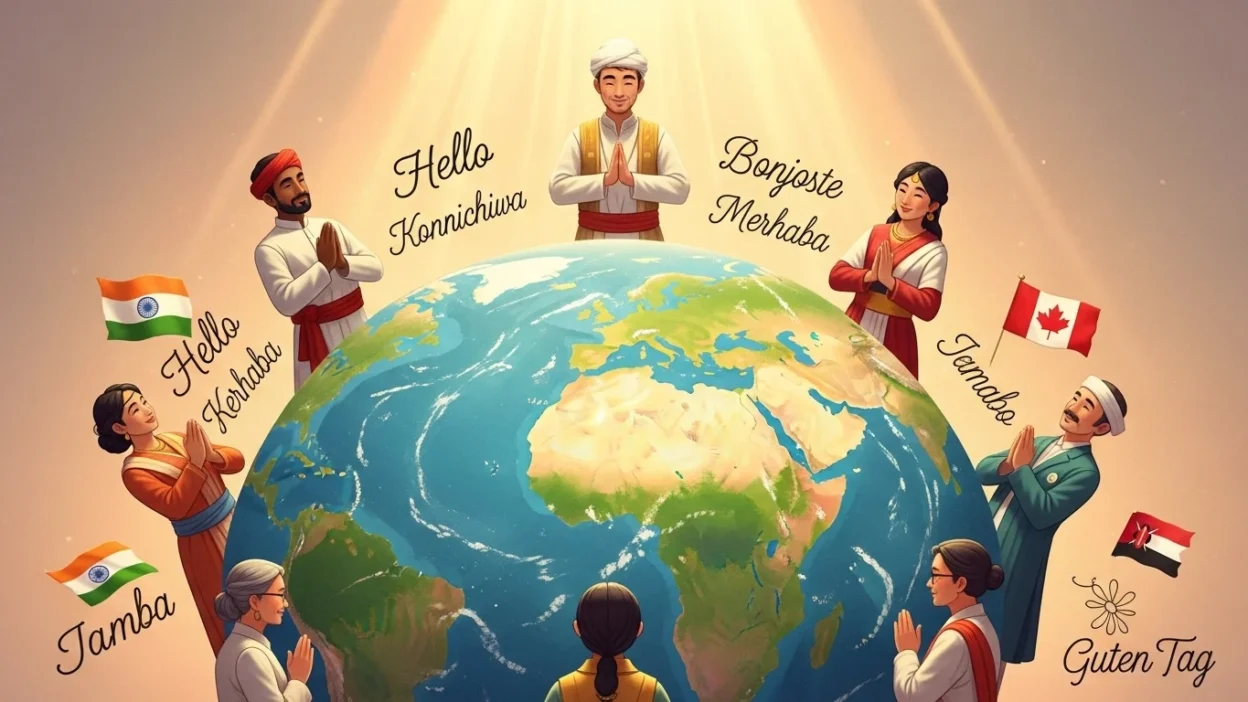
Learning how to say Namaste in different languages helps you understand how cultures greet each other with respect, humility, and warmth.
While “Namaste” originates from Sanskrit and is widely used in India and Nepal, nearly every culture has its own respectful greeting that carries a similar meaning.
Because greetings are the foundation of communication, knowing these equivalents improves travel experiences, professional interactions, and cross-cultural friendships.
Moreover, many greetings reflect deep cultural values such as peace, honor, and goodwill. Therefore, exploring Namaste equivalents worldwide strengthens both language skills and cultural awareness.
Below is a structured table with the language first, followed by the native greeting and a simple example sentence.
| Language | Native Greeting | Example Sentence |
|---|---|---|
| Sanskrit | नमस्ते | नमस्ते, मित्र। |
| Hindi | नमस्ते | नमस्ते, आप कैसे हैं? |
| Urdu | سلام | سلام، آپ کیسے ہیں؟ |
| Nepali | नमस्ते | नमस्ते, तपाईंलाई भेटेर खुशी लाग्यो। |
| Bengali | নমস্কার | নমস্কার, কেমন আছেন? |
| Punjabi | ਸਤ ਸ੍ਰੀ ਅਕਾਲ | ਸਤ ਸ੍ਰੀ ਅਕਾਲ ਜੀ। |
| Gujarati | નમસ્તે | નમસ્તે, તમે કેમ છો? |
| Marathi | नमस्कार | नमस्कार, कसे आहात? |
| Tamil | வணக்கம் | வணக்கம், எப்படி இருக்கிறீர்கள்? |
| Telugu | నమస్కారం | నమస్కారం, మీరు ఎలా ఉన్నారు? |
| Kannada | ನಮಸ್ಕಾರ | ನಮಸ್ಕಾರ, ಹೇಗಿದ್ದೀರಿ? |
| Malayalam | നമസ്കാരം | നമസ്കാരം, സുഖമാണോ? |
| Sinhala | ආයුබෝවන් | ආයුබෝවන්, ඔබට කොහොමද? |
| Thai | สวัสดี | สวัสดีครับ |
| Chinese (Mandarin) | 你好 | 你好,很高兴见到你。 |
| Japanese | こんにちは | こんにちは、お元気ですか。 |
| Korean | 안녕하세요 | 안녕하세요, 만나서 반갑습니다. |
| Arabic | مرحبا | مرحبا، كيف حالك؟ |
| Hebrew | שלום | שלום, מה שלומך? |
| Persian | سلام | سلام، حال شما چطور است؟ |
| Turkish | Merhaba | Merhaba, nasılsın? |
| Spanish | Hola | Hola, ¿cómo estás? |
| French | Bonjour | Bonjour, comment allez-vous? |
| German | Hallo | Hallo, wie geht es dir? |
| Italian | Ciao | Ciao, come stai? |
| Portuguese | Olá | Olá, como está? |
| Russian | Здравствуйте | Здравствуйте, как дела? |
| Ukrainian | Вітаю | Вітаю, як справи? |
| Polish | Cześć | Cześć, jak się masz? |
| Czech | Ahoj | Ahoj, jak se máš? |
| Slovak | Ahoj | Ahoj, ako sa máš? |
| Hungarian | Szia | Szia, hogy vagy? |
| Romanian | Salut | Salut, ce faci? |
| Greek | Γεια σας | Γεια σας, τι κάνετε; |
| Dutch | Hallo | Hallo, hoe gaat het? |
| Swedish | Hej | Hej, hur mår du? |
| Danish | Hej | Hej, hvordan har du det? |
| Norwegian | Hei | Hei, hvordan går det? |
| Finnish | Hei | Hei, mitä kuuluu? |
| Icelandic | Halló | Halló, hvernig hefurðu það? |
| Irish | Dia dhuit | Dia dhuit, conas atá tú? |
| Welsh | Helo | Helo, sut wyt ti? |
| Basque | Kaixo | Kaixo, zer moduz? |
| Maltese | Bongu | Bongu, kif inti? |
| Armenian | Բարեւ | Բարեւ, ինչպես եք? |
| Georgian | გამარჯობა | გამარჯობა, როგორ ხარ? |
| Azerbaijani | Salam | Salam, necəsən? |
| Uzbek | Salom | Salom, qalaysan? |
| Kazakh | Сәлем | Сәлем, қалайсың? |
| Mongolian | Сайн байна уу | Сайн байна уу, та сайн уу? |
| Albanian | Përshëndetje | Përshëndetje, si je? |
| Macedonian | Здраво | Здраво, како си? |
| Serbian | Здраво | Здраво, како си? |
| Croatian | Bok | Bok, kako si? |
| Bosnian | Zdravo | Zdravo, kako si? |
| Slovenian | Živjo | Živjo, kako si? |
| Swahili | Habari | Habari, hujambo? |
| Zulu | Sawubona | Sawubona, unjani? |
| Xhosa | Molo | Molo, unjani? |
| Afrikaans | Hallo | Hallo, hoe gaan dit? |
| Somali | Salaan | Salaan, sidee tahay? |
| Amharic | ሰላም | ሰላም, እንዴት ነህ? |
| Filipino | Kumusta | Kumusta ka? |
| Indonesian | Halo | Halo, apa kabar? |
| Malay | Hai | Hai, apa khabar? |
| Vietnamese | Xin chào | Xin chào, bạn khỏe không? |
| Khmer | សួស្តី | សួស្តី, អ្នកសុខសប្បាយទេ? |
| Lao | ສະບາຍດີ | ສະບາຍດີ, ເຈົ້າເປັນແນວໃດ? |
| Haitian Creole | Bonjou | Bonjou, kijan ou ye? |
| Latin | Salve | Salve, quomodo vales? |
Why Learning Namaste Equivalents Matters
First, greetings set the tone for every interaction. Moreover, using the local equivalent of Namaste shows cultural respect and awareness. In addition, understanding different greeting traditions deepens appreciation for global customs and social etiquette. Therefore, learning these expressions strengthens both communication skills and intercultural understanding.
Conclusion
Learning how to say Namaste in different languages opens the door to respectful and meaningful communication worldwide.
Because greetings carry cultural identity and emotional warmth, using them correctly builds trust and connection.
Moreover, exploring global equivalents highlights the shared human value of kindness and respect.
Ultimately, whether you say Namaste, Hola, Salaam, or Bonjour, the intention behind the greeting unites people across cultures and languages.

Nicodemo Thorley is a cultural writer at Lingonast.com, focusing on language and heritage.
He explores how language connects with culture and history.
His articles offer structured and insightful perspectives.