
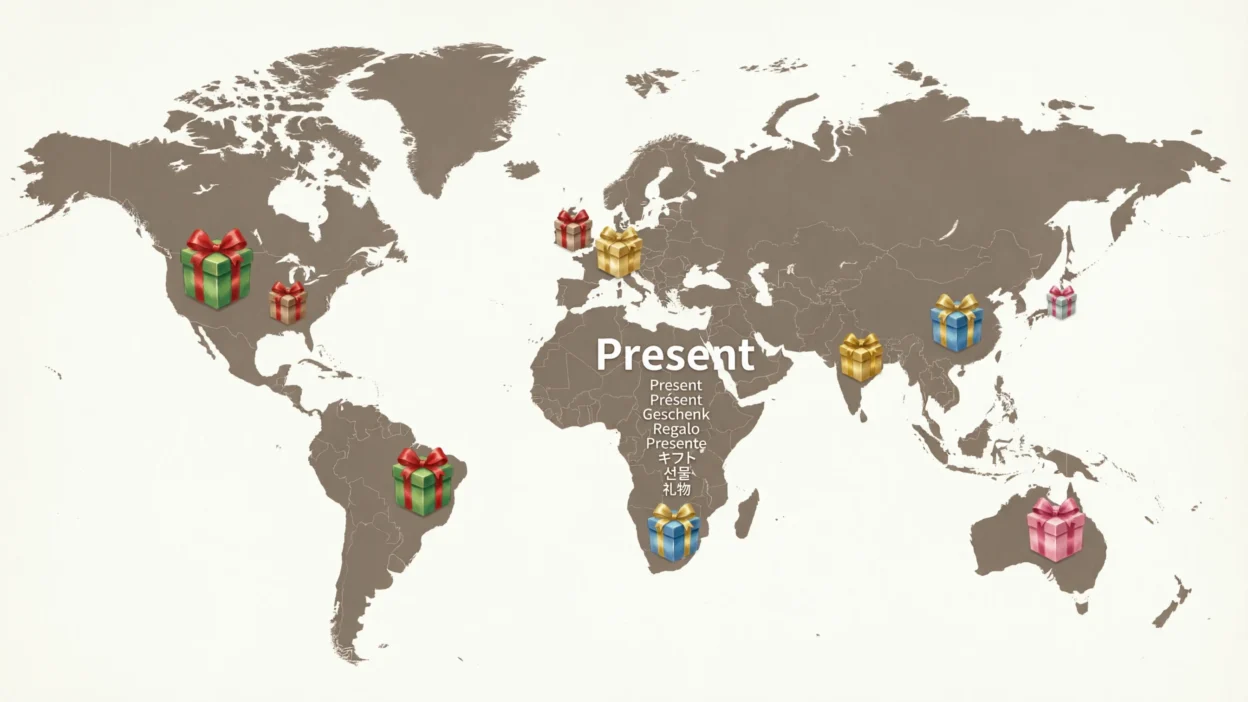
Because communication connects cultures, understanding how to say present in different languages strengthens relationships instantly.
Moreover, the word present can mean a gift, something happening now, or being physically available; therefore, context matters greatly when translating it worldwide.
Additionally, travelers, students, and professionals benefit from accurate vocabulary because clarity prevents misunderstandings. Furthermore, learning multiple translations builds cultural awareness and confidence.
Consequently, this comprehensive guide provides languages in a structured format to help you expand vocabulary effectively while improving global communication skills in practical, real-life situations.
| Language | Translation | Language | Translation |
|---|---|---|---|
| English | Present | Spanish | Regalo |
| French | Cadeau | German | Geschenk |
| Italian | Regalo | Portuguese | Presente |
| Dutch | Cadeau | Swedish | Present |
| Norwegian | Gave | Danish | Gave |
| Finnish | Lahja | Icelandic | Gjöf |
| Russian | Подарок | Ukrainian | Подарунок |
| Polish | Prezent | Czech | Dárek |
| Slovak | Darček | Hungarian | Ajándék |
| Romanian | Cadou | Bulgarian | Подарък |
| Greek | Δώρο | Turkish | Hediye |
| Albanian | Dhuratë | Serbian | Poklon |
| Croatian | Poklon | Bosnian | Poklon |
| Slovenian | Darilo | Macedonian | Подарок |
| Lithuanian | Dovana | Latvian | Dāvana |
| Estonian | Kingitus | Maltese | Rigal |
| Irish | Bronntanas | Welsh | Anrheg |
| Basque | Opari | Catalan | Regal |
| Galician | Agasallo | Afrikaans | Geskenk |
| Swahili | Zawadi | Zulu | Isipho |
| Xhosa | Isipho | Yoruba | Ẹ̀bùn |
| Igbo | Onyinye | Hausa | Kyauta |
| Somali | Hadiyad | Amharic | ስጦታ |
| Arabic | هدية | Hebrew | מתנה |
| Persian | هدیه | Urdu | تحفہ |
| Hindi | उपहार | Bengali | উপহার |
| Punjabi | ਤੋਹਫ਼ਾ | Gujarati | ભેટ |
| Marathi | भेट | Tamil | பரிசு |
| Telugu | బహుమతి | Kannada | ಉಡುಗೊರೆ |
| Malayalam | സമ്മാനം | Sinhala | තෑග්ග |
| Nepali | उपहार | Thai | ของขวัญ |
| Vietnamese | Món quà | Indonesian | Hadiah |
| Malay | Hadiah | Filipino | Regalo |
| Chinese (Mandarin) | 礼物 | Japanese | プレゼント |
| Korean | 선물 | Mongolian | Бэлэг |
| Khmer | អំណោយ | Lao | ຂອງຂວັນ |
| Burmese | လက်ဆောင် | Tibetan | ལག་རྟགས |
| Georgian | საჩუქარი | Armenian | Նվեր |
| Azerbaijani | Hədiyyə | Kazakh | Сыйлық |
| Uzbek | Sovg‘a | Turkmen | Sowgat |
| Kyrgyz | Белек | Tajik | Тӯҳфа |
| Pashto | ډالۍ | Kurdish | Diyari |
| Malagasy | Fanomezana | Maori | Koha |
| Hawaiian | Makana | Samoan | Meaalofa |
| Tongan | Meʻaʻofa | Fijian | Sovu |
| Haitian Creole | Kado | Luxembourgish | Kaddo |
| Belarusian | Падарунак | Breton | Donezon |
| Corsican | Rigalu | Frisian | Kado |
| Scottish Gaelic | Tiodhlac | Manx | Present |
| Occitan | Regal | Sardinian | Regalu |
| Esperanto | Donaco | Latin | Donum |
| Quechua | Regalo | Aymara | Regalo |
| Guarani | Jopói | Nahuatl | Tlaocol |
| Navajo | Biyeʼ | Cherokee | ᎧᎵᎩ |
| Inuktitut | Tunissut | Greenlandic | Tunissut |
| Mapudungun | Ülmen | Wolof | Jox |
| Shona | Chipo | Kinyarwanda | Impano |
| Kirundi | Ingabire | Luganda | Ekirabo |
| Sesotho | Mpho | Tswana | Mpho |
| Tigrinya | ህያብ | Oromo | Kennaa |
| Dari | هدیه | Chichewa | Mphatso |
| Sindhi | تحفو | Kashmiri | تحفہ |
| Konkani | भेट | Bhojpuri | उपहार |
| Santali | Upohar | Dogri | उपहार |
| Maithili | उपहार | Manipuri | ꯄꯨꯛꯆꯦꯜ |
| Khmer (alt) | Kado | Javanese | Hadiah |
| Sundanese | Hadiah | Cebuano | Gasa |
| Hmong | Khoom plig | Uyghur | سوۋغا |
| Dzongkha | ལག་རྟགས | Marshallese | Kōn̄aan |
| Palauan | Kado | Chamorro | Regalo |
| Tahitian | Ôroʻa | Tok Pisin | Presen |
| Ndebele | Isipho | Venda | Tshifhiwa |
| Sotho | Mpho | Afar | Hadiyya |
| Bambara | Kado | Ewe | Nunana |
| Fula | Dokkal | Kanuri | Kyauta |
| Twi | Akyɛde | Lingala | Likabo |
| Swati | Sipho | Ganda | Ekirabo |
| Chewa | Mphatso | Akan | Akyɛde |
| Bemba | Icipelwa | Luo | Mich |
| Zarma | Kyauta | Berber | Tawriqt |
| Kabyle | Tawriqt | Maltese (alt) | Rigal |
| Romani | Kado | Ladino | Regalo |
| Aragonese | Regal | Asturian | Regalu |
| Walloon | Cadea | Faroese | Gáva |
| Cornish | Rys | Guernésiais | Cadeau |
| Jersey French | Cadeau | Mirandese | Regalo |
| Silesian | Podarek | Lombard | Regal |
| Sicilian | Rigalu | Venetian | Regalo |
| Occitan (Gascon) | Regal | Provençal | Regal |
How to Use the Word Present Correctly
First, identify the context because present can mean a gift, current time, or attendance. For example, in most translations above, the meaning refers to a gift. However, if you mean “I am present,” translations change significantly in many languages. Therefore, always confirm usage before speaking.
Cultural Importance of Giving Presents
Gift-giving traditions differ widely across cultures. For instance, Japanese culture values presentation and wrapping, while many Middle Eastern cultures emphasize generosity and hospitality. Consequently, understanding both the word and the tradition improves intercultural communication.
Frequently Asked Questions
What is the most common translation of present worldwide?
Most languages translate present as a word meaning gift, such as regalo, cadeau, or hediye.
Does present always mean gift?
No. Present can also mean current time or being physically available.
Why do translations vary slightly?
Dialects, regional vocabulary, and writing systems create small differences.
Is pronunciation important?
Yes. Correct pronunciation improves clarity and shows cultural respect.
Final Thought
Learning how to say present in different languages expands more than vocabulary; it builds cultural awareness, strengthens communication skills, and encourages global understanding.
When you explore multilingual expressions, you gain confidence in travel, education, and professional settings.
Therefore, continue practicing new words daily because consistent exposure transforms simple vocabulary into powerful communication tools that connect people worldwide.

Nicodemo Thorley is a cultural writer at Lingonast.com, focusing on language and heritage.
He explores how language connects with culture and history.
His articles offer structured and insightful perspectives.