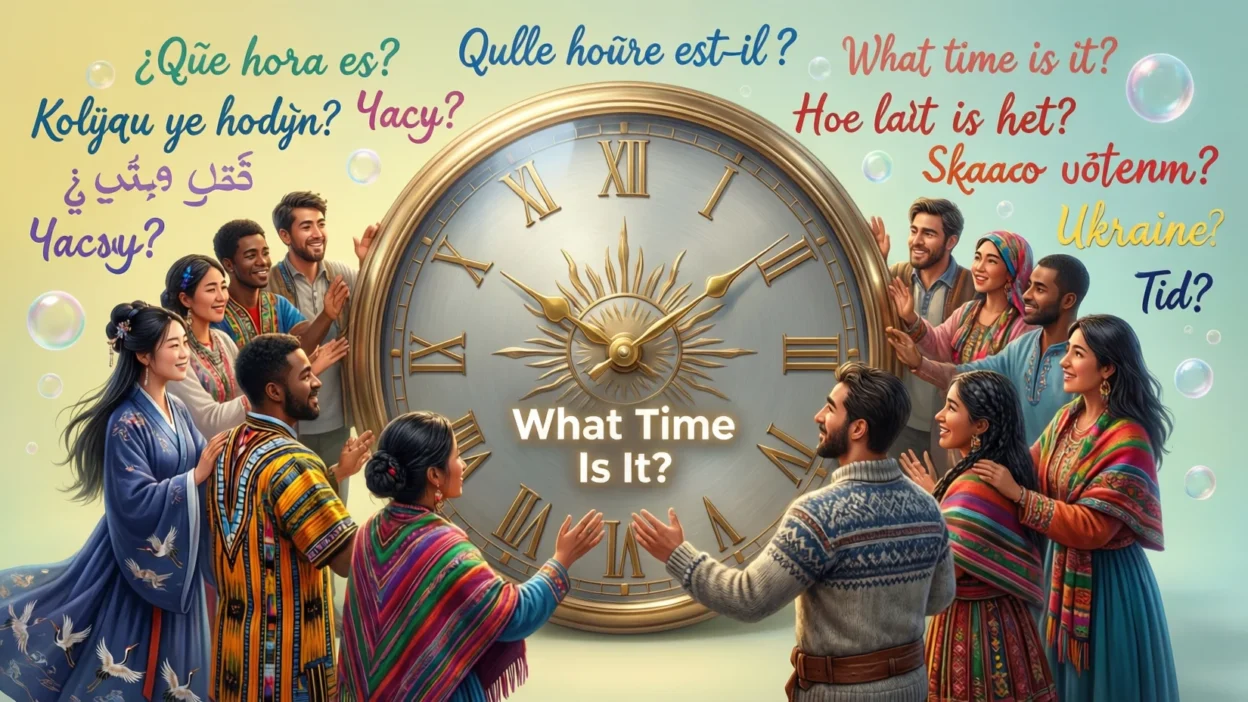
What time is it in different languages is one of the most useful questions you can learn when communicating across cultures.
Whether you are traveling, working internationally, studying a new language, or chatting online, this phrase helps you manage schedules and avoid confusion.
Moreover, asking about time is polite, practical, and universally understood. Therefore, learning how to say this simple question can greatly improve everyday conversations around the world.
In addition, understanding this phrase allows you to connect more naturally with native speakers.
It shows effort, respect, and interest in their language. As a result, even basic knowledge like this can make interactions smoother and more friendly.
What Time Is It in 70 Different Languages
How do people ask “what time is it” around the world?
| No. | Language | Native Phrase | Easy Pronunciation | Example Sentence | English Meaning |
|---|---|---|---|---|---|
| 1 | English | What time is it? | wot time iz it | What time is it now? | Asking the current time |
| 2 | Spanish | ¿Qué hora es? | keh o-ra es | ¿Qué hora es ahora? | What time is it now? |
| 3 | French | Quelle heure est-il ? | kel ur eh-teel | Quelle heure est-il maintenant | What time is it now? |
| 4 | German | Wie spät ist es? | vee shpayt ist es | Wie spät ist es jetzt? | What time is it now? |
| 5 | Italian | Che ore sono? | keh o-re so-no | Che ore sono adesso? | What time is it now? |
| 6 | Portuguese | Que horas são? | keh o-ras sao | Que horas são agora? | What time is it now? |
| 7 | Dutch | Hoe laat is het? | hoo laat is het | Hoe laat is het nu? | What time is it now? |
| 8 | Russian | Который час? | ka-to-ree chas | Который час сейчас | What time is it now? |
| 9 | Arabic | كم الساعة؟ | kam as-sa-ah | كم الساعة الآن؟ | What time is it now? |
| 10 | Hindi | क्या समय हुआ है? | kya sa-may hu-aa | अभी क्या समय है | What time is it now? |
| 11 | Urdu | کیا وقت ہوا ہے؟ | kya waqt hu-a | ابھی کیا وقت ہے | What time is it now? |
| 12 | Japanese | 何時ですか? | nan-ji des-ka | 今何時ですか | What time is it now? |
| 13 | Chinese | 现在几点? | shyan-zai jee-dyan | 现在几点了 | What time is it now? |
| 14 | Korean | 지금 몇 시예요? | ji-gum myot shi-eh-yo | 지금 몇 시예요 | What time is it now? |
| 15 | Turkish | Saat kaç? | saat kach | Saat kaç şimdi? | What time is it now? |
| 16 | Greek | Τι ώρα είναι; | tee o-ra ee-ne | Τι ώρα είναι τώρα | What time is it now? |
| 17 | Polish | Która jest godzina? | ktoo-ra yest go-jee-na | Która jest godzina teraz | What time is it now? |
| 18 | Swedish | Vad är klockan? | vad er klok-kan | Vad är klockan nu | What time is it now? |
| 19 | Norwegian | Hva er klokka? | hva er klok-ka | Hva er klokka nå | What time is it now? |
| 20 | Danish | Hvad er klokken? | hva er klok-en | Hvad er klokken nu | What time is it now? |
| 21 | Finnish | Paljonko kello on? | pal-yon-ko kel-lo on | Paljonko kello on nyt | What time is it now? |
| 22 | Czech | Kolik je hodin? | ko-lik yeh ho-din | Kolik je hodin teď | What time is it now? |
| 23 | Hungarian | Mennyi az idő? | men-yee az ee-do | Mennyi az idő most | What time is it now? |
| 24 | Romanian | Cât este ceasul? | kut es-te cha-sul | Cât este ceasul acum | What time is it now? |
| 25 | Bulgarian | Колко е часът? | kol-ko eh cha-sut | Колко е часът сега | What time is it now? |
| 26 | Ukrainian | Котра година? | ko-tra ho-dee-na | Котра година зараз | What time is it now? |
| 27 | Hebrew | מה השעה? | ma ha-sha-ah | מה השעה עכשיו | What time is it now? |
| 28 | Thai | กี่โมงแล้ว | gee mong leo | ตอนนี้กี่โมง | What time is it now? |
| 29 | Vietnamese | Mấy giờ rồi? | may zyo roy | Bây giờ mấy giờ rồi | What time is it now? |
| 30 | Indonesian | Jam berapa? | jam be-ra-pa | Sekarang jam berapa | What time is it now? |
| 31 | Malay | Pukul berapa? | poo-kul be-ra-pa | Sekarang pukul berapa | What time is it now? |
| 32 | Filipino | Anong oras na? | a-nong o-ras na | Anong oras na ngayon | What time is it now? |
| 33 | Swahili | Saa ngapi? | saa nga-pee | Saa ngapi sasa | What time is it now? |
| 34 | Zulu | Yisikhathi sini? | yee-si-kha-thee | Yisikhathi sini manje | What time is it now? |
| 35 | Afrikaans | Hoe laat is dit? | hoo laat is dit | Hoe laat is dit nou | What time is it now? |
| 36 | Persian | ساعت چند است؟ | sa-at chand ast | الان ساعت چند است | What time is it now? |
| 37 | Bengali | এখন কয়টা বাজে? | e-khon koy-ta ba-je | এখন কয়টা বাজে | What time is it now? |
| 38 | Tamil | இப்போது எத்தனை மணி? | ip-po-thu eth-tha-ni | இப்போது எத்தனை மணி | What time is it now? |
| 39 | Punjabi | ਹੁਣ ਕਿੰਨਾ ਵੱਜਿਆ? | hun kin-na va-jya | ਹੁਣ ਕਿੰਨਾ ਵੱਜਿਆ | What time is it now? |
| 40 | Nepali | अहिले कति बजे? | ahi-le ka-ti ba-je | अहिले कति बजे | What time is it now? |
| 41 | Marathi | आत्ता किती वाजले? | aat-ta ki-ti vaaj-le | आत्ता किती वाजले | What time is it now? |
| 42 | Gujarati | અત્યારે કેટલા વાગ્યા? | a-tya-re ket-la | અત્યારે કેટલા વાગ્યા | What time is it now? |
| 43 | Telugu | ఇప్పుడు ఎంత సమయం? | ip-pu-du en-tha | ఇప్పుడు ఎంత సమయం | What time is it now? |
| 44 | Kannada | ಈಗ ಎಷ್ಟು ಗಂಟೆ? | eeg es-tu gan-te | ಈಗ ಎಷ್ಟು ಗಂಟೆ | What time is it now? |
| 45 | Malayalam | ഇപ്പോൾ സമയം എത്ര? | ip-pol sa-ma-yam | ഇപ്പോൾ സമയം എത്ര | What time is it now? |
| 46 | Sinhala | දැන් කීයද? | den kee-ya-da | දැන් කීයද | What time is it now? |
| 47 | Pashto | اوس څو بجې دي؟ | os tso ba-je | اوس څو بجې دي | What time is it now? |
| 48 | Kurdish | Saet çend e? | sa-et chend eh | Saet çend e niha | What time is it now? |
| 49 | Somali | Saacaddu waa imisa? | saa-cad-du waa | Saacaddu waa imisa hadda | What time is it now? |
| 50 | Amharic | ሰዓቱ ስንት ነው? | se-a-tu sint new | ሰዓቱ ስንት ነው | What time is it now? |
| 51 | Lao | ຈັກໂມງແລ້ວ | jak mong leo | ຈັກໂມງແລ້ວ | What time is it now? |
| 52 | Khmer | ម៉ោងប៉ុន្មាន? | maong bon-man | ឥឡូវម៉ោងប៉ុន្មាន | What time is it now? |
| 53 | Burmese | ဘယ်နှစ်နာရီရှိပြီလဲ | beh hnit na-yee | ဘယ်နှစ်နာရီရှိပြီ | What time is it now? |
| 54 | Mongolian | Хэдэн цаг болж байна? | he-den tsag | Хэдэн цаг болж байна | What time is it now? |
| 55 | Icelandic | Hvað er klukkan? | kva-th er klo-kan | Hvað er klukkan núna | What time is it now? |
| 56 | Irish | Cén t-am é? | ken tam ay | Cén t-am é anois | What time is it now? |
| 57 | Welsh | Faint o’r gloch yw hi? | faint or glok | Faint o’r gloch yw hi | What time is it now? |
| 58 | Scottish Gaelic | Dè an uair a tha e? | jay an oo-er | Dè an uair a tha e | What time is it now? |
| 59 | Basque | Zer ordu da? | zer or-do da | Zer ordu da orain | What time is it now? |
| 60 | Catalan | Quina hora és? | kee-na o-ra es | Quina hora és ara | What time is it now? |
| 61 | Serbian | Koliko je sati? | ko-lee-ko ye sa-tee | Koliko je sati sada | What time is it now? |
| 62 | Croatian | Koliko je sati? | ko-lee-ko ye sa-tee | Koliko je sati sada | What time is it now? |
| 63 | Slovak | Koľko je hodín? | kol-ko ye ho-deen | Koľko je hodín teraz | What time is it now? |
| 64 | Slovenian | Koliko je ura? | ko-lee-ko ye oo-ra | Koliko je ura zdaj | What time is it now? |
| 65 | Estonian | Mis kell on? | mis kell on | Mis kell on praegu | What time is it now? |
| 66 | Latvian | Cik ir pulkstenis? | tsik ir poolk | Cik ir pulkstenis tagad | What time is it now? |
| 67 | Lithuanian | Kiek valandų? | keek va-lan-du | Kiek valandų dabar | What time is it now? |
| 68 | Albanian | Sa është ora? | sa esht o-ra | Sa është ora tani | What time is it now? |
| 69 | Armenian | Ժամը քանիսն է? | zha-meh ka-nis | Ժամը քանիսն է | What time is it now? |
| 70 | Georgian | რომელი საათია? | ro-me-li saa-ti | რომელი საათია | What time is it now? |
Why Learning This Phrase Is Important
How does asking about time help daily communication?
Firstly, this question helps you manage schedules effectively. Moreover, it avoids misunderstandings when meeting others. Therefore, knowing this phrase makes conversations more practical and efficient.
When and How to Use It Politely
Is it appropriate in all cultures?
Generally, yes. However, tone and timing matter. As a result, asking politely always creates a positive impression.
FAQs
Is this phrase formal or informal?
It can be both, depending on tone and language form.
Can I use it with strangers?
Yes, it is commonly used in public places.
Do languages ask time differently?
Yes, some focus on hours, others on the clock.
Is pronunciation important?
Yes, clear pronunciation improves understanding.
Should I learn how to answer too?
Absolutely, it completes the conversation.
Conclusion
In conclusion, learning how to ask what time is it in different languages is an essential skill for global communication.
Although each language has its own structure and sound, the purpose remains the same everywhere.
Moreover, this phrase helps people stay organized, respectful, and connected.
Therefore, by mastering these translations, you make everyday interactions smoother and more confident wherever you go.

Foster Hollis is a language and culture writer with a strong interest in how people communicate across borders. At Lingonast, he focuses on cultural insights and language based articles that help readers understand global traditions in a simple, engaging way.