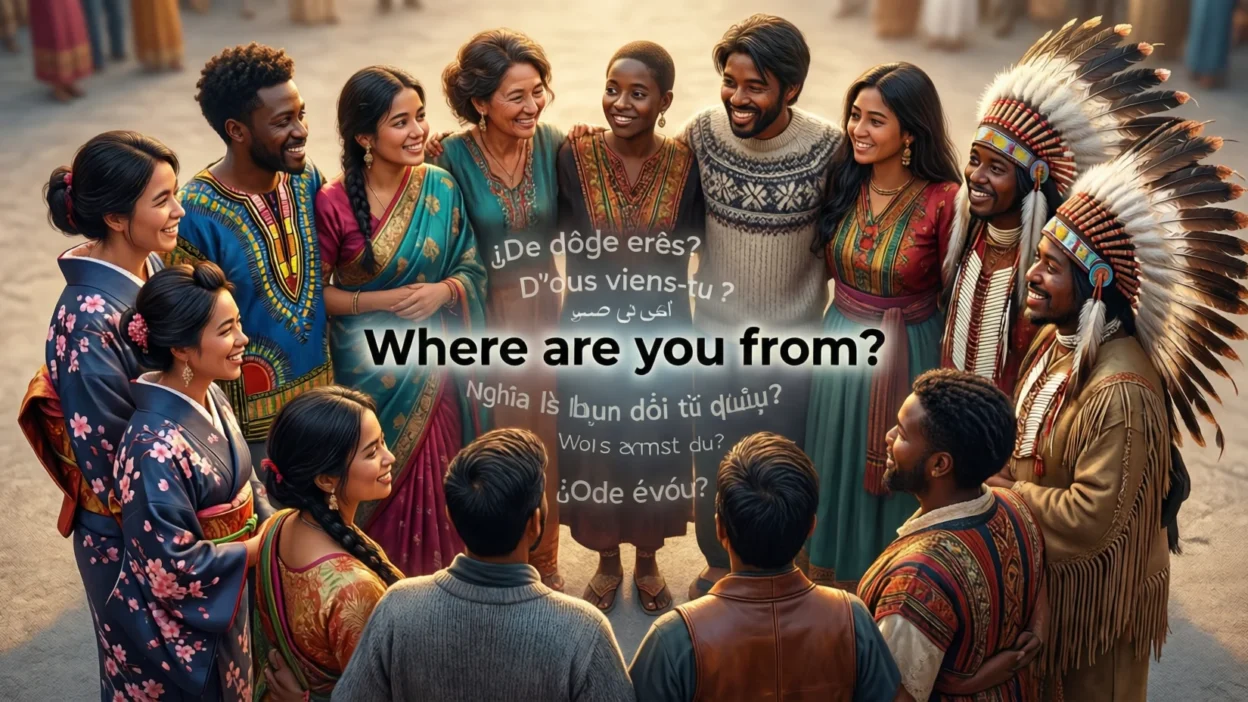
Where are you from in different languages is one of the most common and useful questions in everyday conversations.
When people meet for the first time, they often ask this question to understand background, culture, or origin.
Therefore, learning how to say it correctly helps you communicate politely and confidently.
Moreover, it shows cultural curiosity and respect. As a result, whether you are traveling, studying languages, or meeting people online, this phrase plays a key role in building friendly connections across the world.
Where Are You From in 70 Different Languages
How do people ask “where are you from” around the world?
| No. | Language | Native Phrase | Easy Pronunciation | Example Sentence | English Meaning |
|---|---|---|---|---|---|
| 1 | English | Where are you from? | wair ar yoo frum | Where are you from? | Asking origin |
| 2 | Spanish | ¿De dónde eres? | deh don-de eh-res | ¿De dónde eres? | Where are you from? |
| 3 | French | D’où viens-tu ? | doo vee-en too | D’où viens-tu ? | Where are you from? |
| 4 | German | Woher kommst du? | vo-hair komst doo | Woher kommst du? | Where are you from? |
| 5 | Italian | Di dove sei? | dee do-veh say | Di dove sei? | Where are you from? |
| 6 | Portuguese | De onde você é? | je on-je vo-se eh | De onde você é? | Where are you from? |
| 7 | Dutch | Waar kom je vandaan? | var kom yuh fan-dan | Waar kom je vandaan? | Where are you from? |
| 8 | Russian | Откуда ты? | at-koo-da tee | Откуда ты? | Where are you from? |
| 9 | Arabic | من أين أنت؟ | min ayn ant | من أين أنت؟ | Where are you from? |
| 10 | Hindi | आप कहाँ से हैं? | aap kahaan se hain | आप कहाँ से हैं? | Where are you from? |
| 11 | Urdu | آپ کہاں سے ہیں؟ | aap kahaan se hain | آپ کہاں سے ہیں؟ | Where are you from? |
| 12 | Japanese | どこから来ましたか? | do-ko ka-ra | どこから来ましたか | Where are you from? |
| 13 | Chinese | 你从哪里来? | nee tsong na-lee | 你从哪里来 | Where are you from? |
| 14 | Korean | 어디에서 왔어요? | o-di-e-so wa-ssuh | 어디에서 왔어요 | Where are you from? |
| 15 | Turkish | Nerelisin? | ne-re-li-sin | Nerelisin? | Where are you from? |
| 16 | Greek | Από πού είσαι; | a-po poo ee-say | Από πού είσαι | Where are you from? |
| 17 | Polish | Skąd jesteś? | skont yes-tesh | Skąd jesteś? | Where are you from? |
| 18 | Swedish | Var kommer du ifrån? | var kom-er doo | Var kommer du ifrån | Where are you from? |
| 19 | Norwegian | Hvor er du fra? | hvor er doo fra | Hvor er du fra | Where are you from? |
| 20 | Danish | Hvor er du fra? | hvor er doo fra | Hvor er du fra | Where are you from? |
| 21 | Finnish | Mistä olet kotoisin? | mis-ta o-let | Mistä olet kotoisin | Where are you from? |
| 22 | Czech | Odkud jsi? | od-kood ysee | Odkud jsi? | Where are you from? |
| 23 | Hungarian | Honnan jöttél? | hon-nan | Honnan jöttél? | Where are you from? |
| 24 | Romanian | De unde ești? | de oon-de | De unde ești | Where are you from? |
| 25 | Bulgarian | Откъде си? | ot-ku-de see | Откъде си | Where are you from? |
| 26 | Ukrainian | Звідки ти? | zvid-kee tee | Звідки ти | Where are you from? |
| 27 | Hebrew | מאיפה אתה? | may-ee-fo | מאיפה אתה | Where are you from? |
| 28 | Thai | คุณมาจากไหน | khun ma jaak nai | คุณมาจากไหน | Where are you from? |
| 29 | Vietnamese | Bạn đến từ đâu? | ban den tu dau | Bạn đến từ đâu | Where are you from? |
| 30 | Indonesian | Dari mana kamu? | da-ree ma-na | Dari mana kamu | Where are you from? |
| 31 | Malay | Dari mana awak? | da-ree ma-na | Dari mana awak | Where are you from? |
| 32 | Filipino | Taga-saan ka? | ta-ga sa-an ka | Taga-saan ka? | Where are you from? |
| 33 | Swahili | Unatoka wapi? | oo-na-to-ka wa-pee | Unatoka wapi | Where are you from? |
| 34 | Zulu | Uvelaphi? | oo-veh-la-pee | Uvelaphi? | Where are you from? |
| 35 | Afrikaans | Waar kom jy vandaan? | var kom yai | Waar kom jy vandaan | Where are you from? |
| 36 | Persian | اهل کجایی؟ | ahl ko-ja-ee | اهل کجایی؟ | Where are you from? |
| 37 | Bengali | আপনি কোথা থেকে? | ap-ni ko-tha | আপনি কোথা থেকে | Where are you from? |
| 38 | Tamil | நீங்கள் எங்கிருந்து? | neen-gal en-geer | நீங்கள் எங்கிருந்து | Where are you from? |
| 39 | Punjabi | ਤੁਸੀਂ ਕਿੱਥੋਂ ਹੋ? | too-see kit-thon | ਤੁਸੀਂ ਕਿੱਥੋਂ ਹੋ | Where are you from? |
| 40 | Nepali | तपाईं कहाँबाट? | ta-pa-ee kahaan | तपाईं कहाँबाट | Where are you from? |
| 41 | Marathi | तुम्ही कुठून आहात? | tum-hee koo-thoon | तुम्ही कुठून आहात | Where are you from? |
| 42 | Gujarati | તમે ક્યાંથી છો? | ta-meh kya-thi | તમે ક્યાંથી છો | Where are you from? |
| 43 | Telugu | మీరు ఎక్కడి వారు? | mee-ru ek-ka-di | మీరు ఎక్కడి వారు | Where are you from? |
| 44 | Kannada | ನೀವು ಎಲ್ಲಿಂದ? | nee-voo el-lin-da | ನೀವು ಎಲ್ಲಿಂದ | Where are you from? |
| 45 | Malayalam | നിങ്ങൾ എവിടുന്നാണ്? | nin-gal e-vi-dun | നിങ്ങൾ എവിടുന്നാണ് | Where are you from? |
| 46 | Sinhala | ඔබ කොහෙන්ද? | ob ko-hen-da | ඔබ කොහෙන්ද | Where are you from? |
| 47 | Pashto | ته د کوم ځای یې؟ | ta da kom | ته د کوم ځای یې | Where are you from? |
| 48 | Kurdish | Tu ji ku derê yî? | too jee koo | Tu ji ku derê yî | Where are you from? |
| 49 | Somali | Xaggee ka timid? | hag-gay ka | Xaggee ka timid | Where are you from? |
| 50 | Amharic | ከየት ነህ? | keh-yet neh | ከየት ነህ | Where are you from? |
| 51 | Lao | ເຈົ້າມາຈາກໃສ | chao ma jaak | ເຈົ້າມາຈາກໃສ | Where are you from? |
| 52 | Khmer | អ្នកមកពីណា? | neak mok pi-na | អ្នកមកពីណា | Where are you from? |
| 53 | Burmese | သင်ဘယ်ကလာလဲ | thin beh ka | သင်ဘယ်ကလာလဲ | Where are you from? |
| 54 | Mongolian | Та хаанаас ирсэн бэ? | ta haa-naas | Та хаанаас | Where are you from? |
| 55 | Icelandic | Hvaðan ert þú? | kva-than ert thoo | Hvaðan ert þú | Where are you from? |
| 56 | Irish | Cá as duit? | kaw as dit | Cá as duit | Where are you from? |
| 57 | Welsh | O ble wyt ti? | o ble wit tee | O ble wyt ti | Where are you from? |
| 58 | Scottish Gaelic | Cò às a tha thu? | ko aas ha hoo | Cò às a tha thu | Where are you from? |
| 59 | Basque | Nongoa zara? | non-go-a | Nongoa zara | Where are you from? |
| 60 | Catalan | D’on ets? | don ets | D’on ets | Where are you from? |
| 61 | Serbian | Одакле си? | o-dak-le see | Одакле си | Where are you from? |
| 62 | Croatian | Odakle si? | o-dak-le see | Odakle si | Where are you from? |
| 63 | Slovak | Odkiaľ si? | od-kee-al see | Odkiaľ si | Where are you from? |
| 64 | Slovenian | Od kod si? | od kod see | Od kod si | Where are you from? |
| 65 | Estonian | Kust sa pärit oled? | kust sa | Kust sa pärit oled | Where are you from? |
| 66 | Latvian | No kurienes tu esi? | no koo-ree-nes | No kurienes tu esi | Where are you from? |
| 67 | Lithuanian | Iš kur tu esi? | ish koor too | Iš kur tu esi | Where are you from? |
| 68 | Albanian | Nga je? | nga yeh | Nga je? | Where are you from? |
| 69 | Armenian | Որտեղի՞ց ես | vor-te-ghits | Որտեղի՞ց ես | Where are you from? |
| 70 | Georgian | საიდან ხარ? | sai-dan khar | საიდან ხარ | Where are you from? |
Why Learning This Phrase Is Important
How does it help in communication?
Firstly, this question helps start conversations naturally. Moreover, it builds cultural understanding and trust. As a result, people feel more comfortable sharing about themselves.
When and How to Use It
Is it polite in all cultures?
Generally, it is polite and common. However, tone matters. Therefore, asking respectfully is always important.
FAQs
Is this question considered personal?
Usually no, but context matters.
Can I use it with strangers?
Yes, especially in social or travel situations.
Are these phrases formal or informal?
Both forms exist depending on language and culture.
Should I learn the reply too?
Yes, it improves conversation flow.
Is pronunciation important?
Yes, clear pronunciation helps understanding.
Conclusion
In conclusion, learning how to ask where are you from in different languages is an essential communication skill.
Although languages differ in structure and sound, the intention behind this question remains friendly and respectful.
Moreover, it helps people connect, share stories, and understand cultural backgrounds more deeply.
Therefore, by using these phrases, you open doors to meaningful conversations and global friendships. Ultimately, small questions like this create big connections across the world.

Foster Hollis is a language and culture writer with a strong interest in how people communicate across borders. At Lingonast, he focuses on cultural insights and language based articles that help readers understand global traditions in a simple, engaging way.