
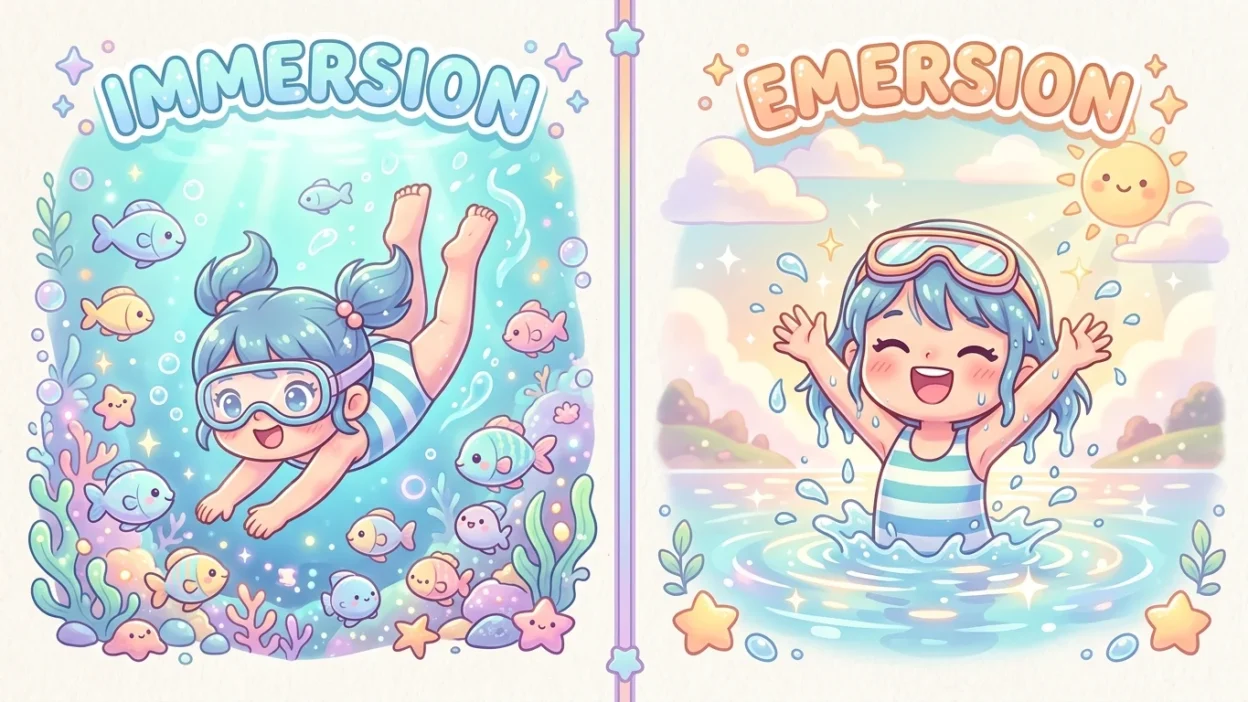
Many English learners and writers confuse emersion vs immersion because the words look almost identical.
However, they have completely different meanings and uses. Using the wrong one can make your sentence sound awkward or incorrect, especially in academic or professional writing.
In this guide, you’ll quickly learn the meaning of each word, their differences, examples, common mistakes, and when to use them correctly in everyday English.
Quick Answer
- Immersion = being deeply involved or fully surrounded by something.
- Emersion = coming out or emerging from something, usually water.
Easy Memory Tip
- Immersion = in
- Emersion = exit
What Does Immersion Mean?
Immersion means complete involvement or deep engagement in something. It is very common in education, gaming, travel, and technology.
Examples
- Language immersion helps students learn faster.
- The movie created a strong sense of immersion.
- Cultural immersion improves communication skills.
Common Phrases
- language immersion
- immersive experience
- cultural immersion
- virtual reality immersion
What Does Emersion Mean?
Emersion means emerging or rising out of water or another environment. This word is mostly used in science and biology.
Examples
- The dolphin’s emersion excited the tourists.
- Scientists studied turtle emersion patterns.
- The diver’s emersion was carefully monitored.
Emersion vs Immersion Comparison Table
| Feature | Immersion | Emersion |
|---|---|---|
| Meaning | Deep involvement | Coming out or emerging |
| Common Usage | Very common | Rare |
| Used In | Education, gaming, travel | Biology, marine science |
| Direction | Going in | Coming out |
Common Mistakes
Incorrect
- French emersion program
Correct
- French immersion program
People often use “emersion” accidentally when talking about language learning. The correct term is always language immersion.
American vs British English
There is no spelling difference between American and British English for these words. Both use:
- immersion
- emersion
However, immersion is much more common in everyday English worldwide.
FAQs
Is emersion a real word?
Yes, but it is mostly used in scientific contexts.
Which word is more common?
Immersion is far more common in modern English.
What is language immersion?
It means learning through complete exposure to a language.
Are immersion and emersion opposites?
In many contexts, yes. One means going in, while the other means coming out.
Is emersion used in everyday conversation?
Rarely. Most people mainly use immersion.
Summary
Understanding emersion vs immersion is simple once you focus on direction and context.
Immersion means deep involvement or being surrounded by something, while emersion means emerging or coming out. Although the words look similar, they are not interchangeable.
In daily English, immersion appears much more often in education, gaming, travel, and technology. Emersion mainly appears in biology and scientific writing. Remembering “immersion = in” can help you avoid common mistakes easily.

Nicodemo Thorley is a cultural writer at Lingonast.com, focusing on language and heritage.
He explores how language connects with culture and history.
His articles offer structured and insightful perspectives.