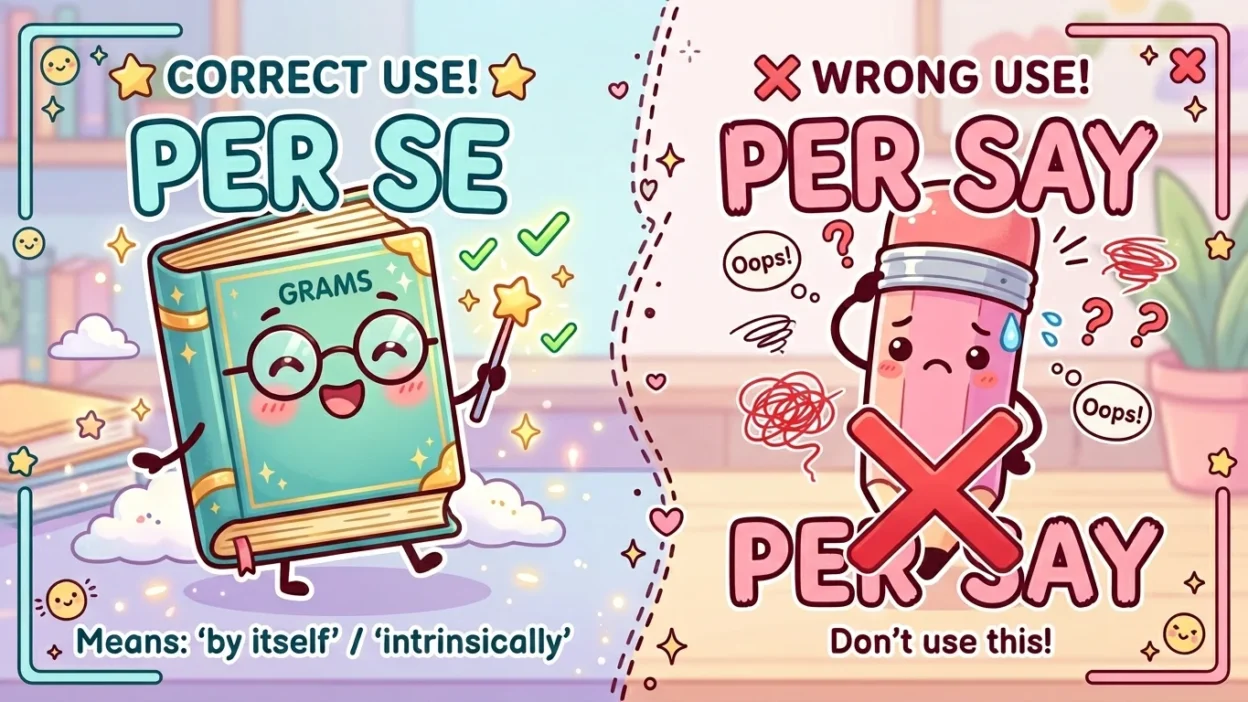
Many English learners confuse per se and per say because they sound exactly alike when spoken. As a result, many people mistakenly write “per say” when they actually mean “per se.”
Quick Answer
✨ Here’s the simple rule:
✅ Per se = correct
❌ Per say = incorrect
🌟 Easy way to remember:
- Per se is a Latin phrase meaning “by itself” or “in itself.”
- Per say is a common misspelling based on pronunciation.
Examples:
- The movie isn’t bad per se. ✔
- The movie isn’t bad per say. ❌
What Does Per Se Mean?
First of all, per se is a Latin expression that means “by itself,” “intrinsically,” or “in itself.”
Therefore, people use it when they want to focus on something alone rather than on related circumstances.
Examples
- The idea isn’t wrong per se.
- Money isn’t evil per se.
- The plan isn’t difficult per se, but it requires patience.
👉 As a result, per se helps clarify that something isn’t inherently good, bad, right, or wrong.
Why Is Per Say Incorrect?
On the other hand, per say is simply a spelling mistake.
Because per se and per say sound nearly identical in speech, many writers assume the phrase contains the word “say.” However, it does not.
Incorrect Examples
❌ I’m not angry per say.
❌ The problem isn’t the price per say.
Correct Versions
✅ I’m not angry per se.
✅ The problem isn’t the price per se.
👉 Therefore, always write per se, never per say.
Per Se vs Per Say: Key Differences
| Phrase | Correctness | Meaning |
|---|---|---|
| Per se | ✅ Correct | By itself, inherently |
| Per say | ❌ Incorrect | Misspelling |
When Should You Use Per Se?
You should use per se when you want to indicate that something is not being considered in a broader context.
Examples
- The policy isn’t unfair per se.
- Social media isn’t harmful per se.
- The technology isn’t dangerous per se.
👉 Consequently, per se often appears in discussions, debates, and formal writing.
Common Mistakes to Avoid
Even though the phrase is common, many people spell it incorrectly.
❌ Incorrect
- It’s not a problem per say.
✅ Correct
- It’s not a problem per se.
❌ Incorrect
- The food wasn’t bad per say.
✅ Correct
- The food wasn’t bad per se.
👉 Therefore, if you’re writing professionally, double-check this phrase carefully.
Easy Trick to Remember
Whenever you feel unsure, remember:
🔹 Per se = correct Latin phrase
🔹 Per say = sounds right but isn’t right
Think:
- “Per se” = “by itself”
Because of this simple trick, you’ll avoid one of the most common spelling mistakes in English.
American vs British English
Interestingly, both American and British English use per se in exactly the same way.
Moreover, neither variety accepts per say as a correct spelling.
Real-Life Examples
Using Per Se
- Success isn’t about money per se.
- The game isn’t difficult per se.
- Exercise isn’t a cure per se, but it can help.
Incorrect Usage
- Success isn’t about money per say. ❌
- The game isn’t difficult per say. ❌
Why This Difference Matters
Although the mistake involves only one letter, it can make your writing look less polished.
When you use the correct spelling:
- Your writing appears more professional.
- Your meaning stays clear.
- Your grammar looks stronger.
- Your credibility improves.
Therefore, learning this distinction is well worth the effort.
FAQs
Which is correct, per se or per say?
Per se is the correct spelling. Per say is a misspelling.
What does per se mean?
It means “by itself,” “in itself,” or “intrinsically.”
Is per say ever correct?
No. Standard English does not recognize per say as correct.
Why do people write per say?
Because per se and per say sound alike when spoken.
Is per se formal?
Yes. However, people also use it in everyday conversations.
Final Thoughts
Now you know that per se is the only correct spelling. While many people write per say because of pronunciation, standard English accepts only per se.
Therefore, whenever you mean “by itself” or “in itself,” choose per se.

Nicodemo Thorley is a cultural writer at Lingonast.com, focusing on language and heritage.
He explores how language connects with culture and history.
His articles offer structured and insightful perspectives.